What's
What's Synchronized Asynchronous Reset
Synchronized Reset
always @(posedge clk ) begin
   if( !rstn ) begin
      dat_r <= 'd0 ;
   end
   else begin
      dat_r <= dat_i ;
   end
end
Asynchronized Reset
always @(posedge clk or negedge rstn ) begin
   if( !rstn ) begin
      dat_r <= 'd0 ;
   end
   else begin
      dat_r <= dat_i ;
   end
end
Synchronized Asynchronized Reset
always @(posedge clk or negedge rstn ) begin
   if( !rstn ) begin
      rstn_chain_r <= 'd0 ;
   end
   else begin
      rstn_chain_r <= {rstn_chain_r,1'b1} ;
   end
end

assign rstn_new = rstn_chain_r[CHAIN_WD-1] ;

always @(posedge clk or negedge rstn_new ) begin
   if( !rstn_new ) begin
      dat_r <= 'd0 ;
   end
   else begin
      dat_r <= dat_i ;
   end
end
Sure, this logic is usually put inside module clkgen.
"rstn" may come from de-glitched pad rstn, signal locked from PLL or any other async source.
What's Data Width Extenstion
A self-determined expression is one where the bit length of the expression is solely determined by the expression itself—for example, an expression representing a delay value.
A context-determined expression is one where the bit length of the expression is determined by the bit length of the expression and by the fact that it is part of another expression. For example, the bit size of the right-hand expression of an assignment depends on itself and the size of the left-hand side.
Multiplication may be performed without losing any overflow bits by assigning the result to something wide enough to hold it.
Expression
Bit length
Comments
unsized constant number
same as integer
sized constant number
as given
i op j, where op is+ - * / % & | ^max(L(i), L(j))
op i, where op is~L(i)
i op j, where op is=== !== == != > >= < <=1 bit
operands are sized to max(L(i),L(j)).
i op j, where op is&& ||1 bit
all operands are self-determined.
op i, where op is& | ^ !1 bit
all operands are self-determined.
i op j, where op is>> << >>> <<<L(i)
j is self-determined.
i ? j : k
max(L(j), L(k))
i is self-determined.
{i,...,j}
L(i) + ... + L(j)
all operands are self-determined.
{i{j,...,k}}
L(i) * (L(j) + ... + L(k))
all operands are self-determined.
codes with bug
wire [16-1 :0]    a ;
wire [16-1 :0]    b ;
wire [16-1 :0]    c ;
assign c = (a + b) >> 1 ;
a possible fix
assign c = (a + b + 0) >> 1 ;
a better fix
wire [17-1 :0]    t ;
assign c = t >> 1 ;
assign t = a + b ;
What's Metastability
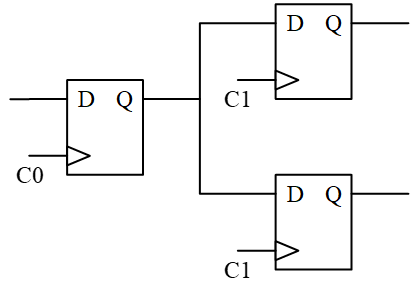
sample a synced signal

sample an unsynced signal

if so, it seems there is no damage, when the sampling clock is very slow

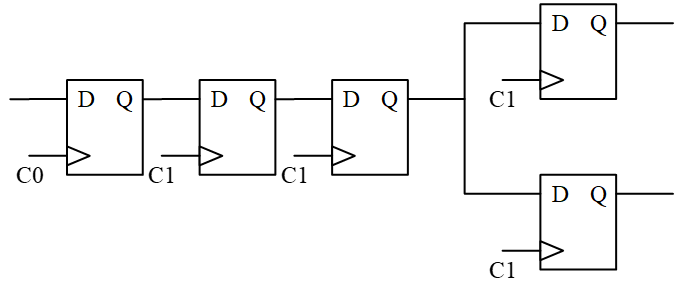
but in fact, the real damage of meta is that different follower may see different value

that's why synchronizers could fix this issue
What's Clock Gating
a SEQ logic with enable
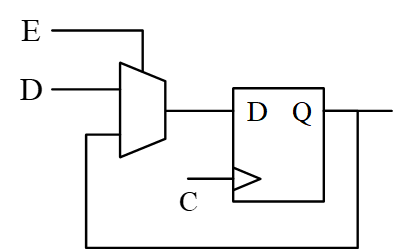
a better implementation
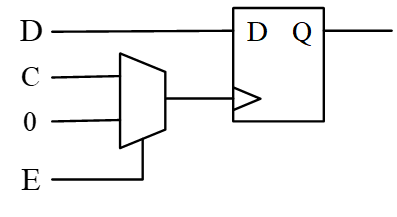
actual circuit uses
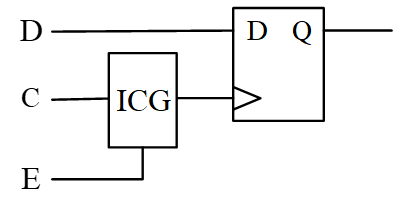
how can we get such a circuit?
auto generated
always @(posedge clk or negative rstn ) begin
   if( !rstn ) begin
      dat_r <= 'd0 ;
   end
   else begin
      if( val_i ) begin
         dat_r <= dat_i ;
      end
    // never write else
    //else begin
    //   dat_r <= dat_r ;
    //end
   end
end
compile_ultra -gate_clock
report_clock_gating -ungated
manually insert
for example, the clock path of SRAMs.
What's Glitch in Simulation
sometimes when we "wait" a output signal from DUT, It may be trigger unexpectedly.
initial begin
   ...
   wait( dut.done_o );
   $finish ;
end
test(
   ...
   done_o
);

output done_o ;

assign done_o = val_i && cnt_x_done_w && cnt_y_done_w ;
it comes from the glitch during simulation.
sample it either in design or in testbench.
due to the same reason, better change inputs at neg edges of clocks.